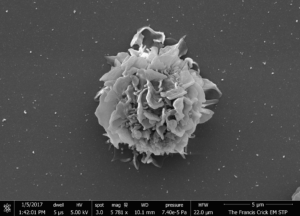
A Deathly Rose
The hallmark feature of “hairy cell” leukaemia cells is the presence of numerous fine, hair-like cytoplasmic projections extending from the cell membrane. These projections give the malignant cells their characteristic “hairy” appearance when viewed under a light microscope. In this scanning electron microscopy image, the cell has the characteristic extensive, irregular, and undulating cytoplasmic ruffles interspersed with numerous short, hair-like projections (microvilli). Hairy Cell Leukaemia is typified by the presence of mutations in BRAF which are found in almost all cases. This mutation causes constitutive activation of the MAP kinase pathway (RAF-MEK-ERK), leading to uncontrolled B-cell proliferation and the changes in the cell’s cytoskeleton seen here.
These abnormal cells accumulate primarily in the bone marrow, spleen, and blood, where they interfere with normal blood cell production. As a result, patients may develop symptoms such as fatigue, increased susceptibility to infections, and enlargement of the spleen. The prognosis for Hairy Cell Leukaemia is generally very good compared with many other leukaemias, especially with modern treatments. It is considered a chronic, slow-growing form of B-cell leukaemia, and most patients respond well to therapy with median overall survival of over 20 years.
Visit
What's on
Learn and play
Youth Scheme
Quick links
Website by Hut Six Digital
