Alien Invaders: HIV Smuggles Its Genetic Code into the Cell’s Control Centre
Áine McKnight, Kelly Marno, Lara Al’Zoubi and Ann P. Wheeler
Human Immunodeficiency Virus type 1 (HIV-1) is a retrovirus that establishes lifelong infection by integrating its genetic material into the host cell genome. In the image described, HIV-1 (89.6 molecular clone) was used to infect human HeLa-CD4 cells for two hours before preparation for visualisation using Structured Illumination Microscopy (SIM) at the UK Node of Euro-BioImaging. SIM is a super-resolution technique that overcomes the resolution limits of conventional light microscopy, enabling detailed visualisation of viral particles that were previously too small to observe within cells.
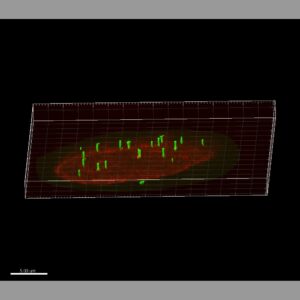
In the image, HIV capsids are shown in green and labelled with the viral p24 protein, a core structural component of the virus. The nuclear membrane is stained red using Lamin B1, which outlines the nucleus and provides structural support. The image captures an early stage of infection following viral entry, where intact or partially disassembled capsids cluster at the nuclear envelope. This accumulation marks a critical point in the HIV life cycle, as the virus must cross the nuclear barrier to establish infection.
During this stage, the viral RNA genome is reverse transcribed into DNA within the capsid as it travels through the cytoplasm. Upon reaching the nuclear envelope, the viral DNA is delivered into the nucleus, where it integrates into the host genome. This integration enables the virus to exploit the host’s transcriptional machinery to produce new viral components, supporting immune evasion and persistence.
This phase of infection is central to research by Aine McKnight and others on host restriction factors that limit HIV replication. Proteins such as TRIM5α, APOBEC3 and SAMHD1 act at early stages of infection, targeting capsid stability, reverse transcription and nuclear entry. The clustering of capsids at the nuclear envelope highlights a vulnerable stage where intrinsic cellular defences can block viral DNA delivery and prevent integration.