Guardian of the Brain
Miranda Colman
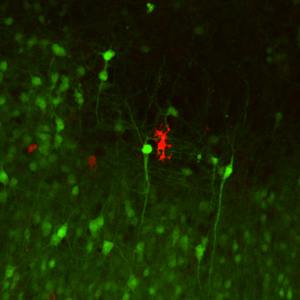
In a thin, living slice of mouse brain, we made neurons (“nerve cells”) glow green and microglia (the brain’s immune cells) glow red. Although you can’t tell from this image, microglia are dynamic guardians of the brain, constantly sending their “arms” out to examine their surroundings! We are interested in whether microglia help or harm neurons in certain disorders, and by filming videos we hope to learn more about them.
This video shows a close-up view of brain cells in a thin, living slice of mouse brain. The bright green cells are neurons, a type of brain cell that sends and receives information. The red cell is a microglia, one of the brain’s immune cells, seen here closely monitoring its surroundings.
Microglia are the brain’s guardians. They constantly survey the brain, keeping it healthy. In this image, the red microglia appears to be standing watch over the green neuron, checking in and staying alert.
This video was taken in a thin slice of mouse brain that we keep alive in a dish. This allows us to observe how brain cells interact with one another while preserving their natural layout, like observing a whole forest rather than a single tree. Using this setup, we can also turn specific genes on or off using non-infectious viruses, which is how we made the neurons glow green and microglia glow red, making it possible to clearly see each cell type.
Microglia play crucial roles in brain health, but their role in brain diseases, such as Alzheimer’s disease, is not fully understood. Sometimes they may protect neurons, fulfilling their function as the brain’s guardian, but other times they may go “rogue” and cause damage.
By tracking these cells over time and introducing disease-related proteins, we can observe how the guardians of the brain respond when neurons are under stress. We hope that by filming videos, we can better understand how microglia and neurons work together.