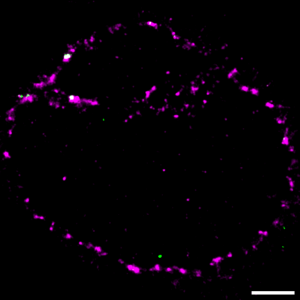
HIV traffics through the nuclear pores of a T cell to complete its lifecycle in the nucleus
Matthew Whelan
When infecting a T cell (white blood cell), HIV1 must transport through the cytoplasm and squeeze through the nuclear pore complex to complete its lifecycle inside the cell’s nucleus. The virus and the nuclear pores are too small to be seen by a normal microscope. Here we use an advanced technique called super-resolution microscopy, which breaks the laws of physics to allow us to to visualise HIV1 virus (green) sitting in the cytoplasm, trafficking through the nuclear pore complex (Magenta) and successfully transporting into the nucleus, which is the empty space inside the ring of nuclear pore complexes (magenta).