What happens to the cells within our skin as we age?
Simranpreet Summan
There are three main layers of the skin: the epidermis, the basement membrane, and the dermis. The basement membrane is a thin (30 nm thick), curvy layer sandwiched between the epidermis (above) and the dermis (below); thus, mechanically supporting our skin!
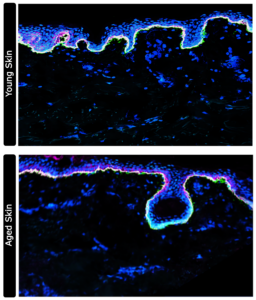
With ageing, this mechanical scaffold weakens, so the skin becomes more wrinkled. This process is associated with the loss of basement membrane structure and the loss of basement membrane proteins called collagens in skin cells (known as ‘basal keratinocytes’). These images show type VII (Col7) and type XVII (Col17) collagens, as well as keratinocyte nuclei (blue). Type VII collagen (green) and type XVII collagen (magenta) are reduced with basement membrane flattening in aged human skin, compared to young.
Looking closely, Col17 is positioned towards the epidermis, whereas Col7 is positioned towards the dermis from the basement membrane. This is because they are structurally different – Col7 forms anchoring fibrils whereas Col17 is present in hemidesmosomes, structures that anchor basal keratinocytes to the basement membrane. This is evident if you zoom in on the circular, loop-like structure in the aged skin image which looks like a forming hair follicle. We can improve the strength and shape of our skin through anti-ageing treatments that enable the addition of basement membrane collagen, making our cells look younger!