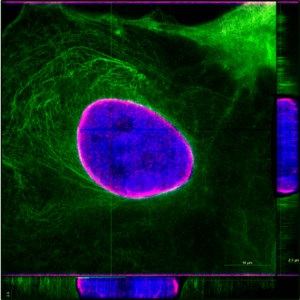
What structures inside a skin cell give it mechanical strength and shape, helping it to resist stretching and damage as we age?
Simranpreet Summan
As we age, our skin becomes more wrinkled and less able to handle mechanical stress, such as stretching. But why? Bones and muscles provide strength and shape to the human body. Similarly, the cytoskeleton and the nucleus inside a cell both act as a mechanical scaffold to protect it from damage, protecting DNA enclosed inside the nucleus.
The nuclear lamina and cytoskeleton are essential for mechanical integrity of keratinocytes (skin cells). This striking super-resolution image highlights the ring-like shaped nuclear lamina, marked by Lamin A/C (magenta) encircling around the nucleus (blue) in a keratinocyte. Lamin A/C is not only restricted to the nuclear periphery and can be detected in the nucleoplasm, within the nuclear interior as shown. The gaps within the nucleus reflect most likely nucleoli, another nuclear landmark. The structures surrounding the nucleus constitute the F-actin cytoskeleton (green).
The skin senses mechanical forces which transmit to the cytoskeleton and the nuclear lamina and finally reaching chromatin (containing DNA) inside the nucleus. This allows a skin cell to physically respond in order to protect your DNA. During ageing, the nuclear lamina deforms becoming structurally weaker and thus, unable to withstand mechanical stress. Targeting nuclear components, including the nuclear lamina may help us to devise anti-ageing strategies for the skin!