How do doctors give oxygen?
Anoushka
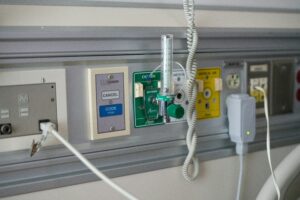
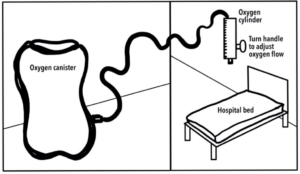
Attached to the wall next to every hospital bed, there’s a small cylinder with an adjustable handle attached. Outside every hospital, there’s a massive lead canister filled with pressurised oxygen. A complex network of tubes running inside the floors and behind the walls of hospitals connect each small cylinder to the massive canister.
There are many reasons why hospital patients might need to breathe extra oxygen – the most common are severe infections (called ‘sepsis’) and lung diseases (for example Asthma, Chronic Obstructive Pulmonary Disease, and Pulmonary Fibrosis).
If a patient needs extra oxygen, they are given an “oxygen mask” to wear that’s connected to the small cylinder on the wall.
Depending on a patient’s oxygen requirement, they get a customised flow rate from the oxygen cylinder and an appropriate oxygen mask for that flow rate.
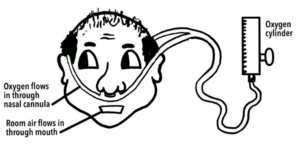
The smallest flow rate of oxygen from the cylinder is 2-4 litres per minute, into an oxygen mask called a nasal cannula.
The patient breathes in a mixture of 100% oxygen from the nasal cannula and normal air (21% oxygen, 70% nitrogen). Overall, a patient using a nasal cannula usually inhales 24-30% oxygen. This is called their fraction of inspired oxygen, or FiO2.
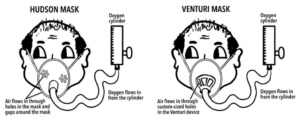
Slightly larger oxygen flow rates from the cylinder (5-10 L/min) require an oxygen mask called a Hudson face mask. As before, the patient breathes a mixture of room air and pure oxygen, achieving a FiO2 of 30-40%.
A “Venturi mask” is a face mask with a special device attached which controls how much room air mixes with the oxygen to precisely control the patient’s FiO2. This allows doctors to know exactly how much oxygen they’re giving to a patient. This is useful because sometimes it’s dangerous to give patients too much oxygen.
Five sizes of Venturi masks allow FiO2s of 24%, 28%, 35%, 40%, and 60%.
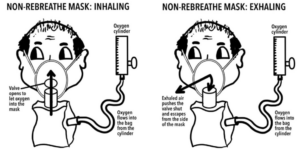
The largest oxygen flow rate from the cylinder is 15L/min – saved for patients who are so desperate for extra oxygen that their FiO2 is made to be over 70%. This requires an oxygen mask called a non-rebreathe mask, which makes an airtight seal over the patient’s mouth and nose. Oxygen flows from the cylinder into a plastic bag attached to the mask. The patient inhales pure oxygen from this bag. When the patient exhales, a rubber flap is pushed to cover the entrance to the bag; exhaled air escapes through the sides of the mask.
In conclusion, oxygen masks comprise one small set from the ingenious, weird and wonderful group of mysterious tubes, wires and cylinders found in a hospital.