What is a lumbar puncture?
By Anoushka
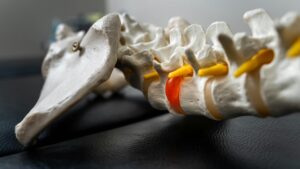
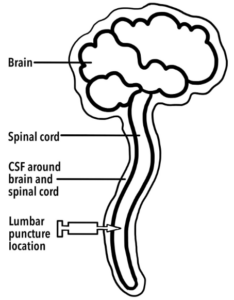
A lumbar puncture is an invasive diagnostic test during which a needle attached to a syringe is poked into a patient’s spinal cord and some fluid from around their spinal cord is sucked into the syringe.
This fluid is called cerebrospinal fluid (shortened to CSF). It surrounds the brain and spinal cord, providing physical protection, nutrients and immunity. Healthy CSF is a clear fluid containing a small amount of protein, a medium amount of glucose, a small number of white blood cells, no red blood cells, and no bacteria, viruses, or fungi.
A lumbar puncture can diagnose bacterial, viral or fungal infections, auto-immune diseases and bleeding affecting the brain and spinal cord.
Abnormal CSF content and colour can indicate various diseases and infections, described below.
- Abnormal colours:
- Red CSF is seen during bleeding into the CSF – as might be expected because blood is red!
- Yellow CSF is seen around 24 hours after bleeding into the CSF because a chemical in red blood cells called haemoglobin breaks down into a yellow chemical called bilirubin.
- Cloudy CSF is seen in bacterial infections because thick, gunky pus is created by the immune system when it fights bacteria.
- Low glucose:
- If there’s a bacterial infection, hungry bacteria in the CSF consume its supply of glucose, so there’s not much left for the nervous system!
- Raised protein:
- When the immune cells are fighting infections from bacteria, viruses or fungi, they create proteins called antibodies and inflammatory cytokines. Bacteria in the CSF produce lots of their own proteins too. Immune cells within the CSF also make extra proteins in autoimmune diseases where the immune system mistakenly attacks cells in the nervous system because they are misidentified as foreign pathogens. Thus, CSF with very high protein indicates a bacterial infection, whereas CSF with moderately high protein indicates a viral or fungal infection, or an autoimmune disease attacking the nervous system.
- High white blood cells:
- Similar to if there’s high protein, high white blood cells in the CSF indicates the immune system fighting an infection from a bacteria, virus, or fungus, or attacking the nervous system due to an autoimmune disease.
- High red blood cells:
- This – alongside red CSF – shows bleeding into the CSF from nearby blood vessels in the brain.
What’s it like for a patient having a lumbar puncture?
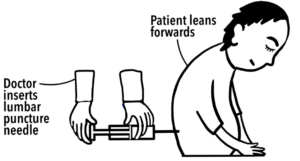
A lumbar puncture usually takes under 30 minutes and patients stay awake during the procedure. Firstly, the patient is instructed to lie on their side, or to sit up and lean forwards. Then, a pain-killer called a local anaesthetic is injected into the patient’s back. Finally, the lumbar puncture needle is inserted, a sample of CSF is taken into the syringe, then the needle is removed and a small plaster is stuck over the insertion site.
Most patients feel fine after a lumbar puncture. However, some patients get pain or infections around the site of needle insertion and a headache caused by the change in pressure around the brain due to CSF removal. Patients are instructed to lie down for a few hours after a lumbar puncture to prevent them from getting a headache, and to take pain-killers such as paracetamol if needed.
Rare but dangerous complications from a lumbar puncture include bacterial infections in the CSF (a patient might feel feverish, nauseous and drowsy with a severe headache, stiff neck and aversion to bright lights) or damage to the spinal cord (patients might have tingling, pins and needles, or muscle weakness in their legs).
Patients with symptoms of dangerous complications in the days following their lumbar puncture are instructed to inform their GP, call 111, or attend A and E.

Visit
What's on
Learn and play
Youth Scheme
Quick links
Website by Hut Six Digital
