What is an epipen?
By Anoushka
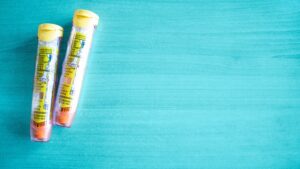
An EpiPen is a clever medical device, slightly taller and wider than a whiteboard marker, used to treat a life-threatening type of allergic reaction called “anaphylaxis” (pronounced ‘anna-phil-ax-iss’).
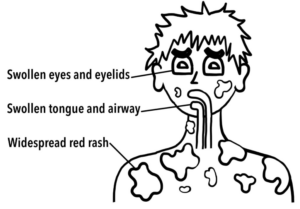
During anaphylaxis, the immune system mistakes innocent substances (e.g. peanuts or antibiotics) for pathogens, and goes crazy in a desperate attempt to fight those substances. This causes a widespread red rash, severe tongue swelling that blocks the airway (this impairs breathing), and a dangerously low blood pressure (this prevents cells receiving enough blood supply).
An EpiPen delivers one dose of treatment for anaphylaxis – which is 0.5ml of adrenaline solution. This is injected into the patient’s thigh through a small needle at one end of the EpiPen.
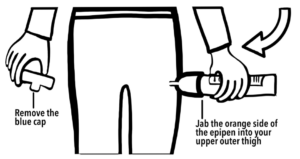
Delivering treatment through an EpiPen involves the following steps:
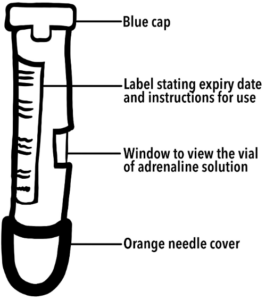
- Check that the EpiPen is in date
- Look through the window to check that the adrenaline solution is clear and colourless
- Remove the blue cap
- Hold the EpiPen in your fist and swing it towards your outer thigh; hold it there for 3-5 seconds.
- Remove the EpiPen.
- Find a safe place to sit or lie down and call an ambulance. Keep the used EpiPen device to show the ambulance.
If a patient suffering from anaphylaxis feels too unwell to independently use their EpiPen, another person can give them the injection, following the six steps described above. It’s likely that this other person will have saved the patient’s life.
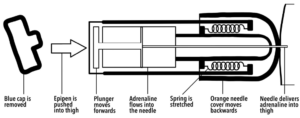
The internal mechanism of an EpiPen is cleverly designed. It is made from a blue plastic cap which prevents a plunger from moving. The plunger is attached to a vial of adrenaline, which is attached to a needle. When the plunger moves forwards, it pushes a dose of adrenaline through the needle. The needle is shielded by an orange cover attached to a spring. When the spring is stretched, the cap moves backwards so the needle pokes out.
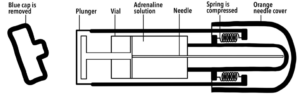
If the blue cap is removed, jabbing the EpiPen into your thigh stretches the spring which moves the orange cover backwards while moving the plunger forwards. This means that the needle pokes into your thigh while a dose of adrenaline flows through the needle. Removing the EpiPen from your thigh allows the spring to relax, so the orange cover shields the needle again.
How does adrenaline treat anaphylaxis?
Adrenaline is a chemical released by the sympathetic nervous system to induce a ‘fight or flight’ response in the body. This ‘fight or flight’ response involves widening the airways, increasing the blood pressure, and decreasing signals from the immune system. Wider airways enable more breathing. Increased blood pressure enables more blood to get to muscle cells. Decreasing signals from the immune system enables the body to feel less pain and experience less swelling. These three things are very useful in a ‘fight or flight’ situation. They are also very useful during anaphylaxis, where the hyperactive immune system causes swelling and pain alongside narrowing of the airways which inhibits breathing and widening of blood vessels which decreases the blood pressure.



Visit
What's on
Learn and play
Youth Scheme
Quick links
Website by Hut Six Digital
