What is asthma?
By Anoushka

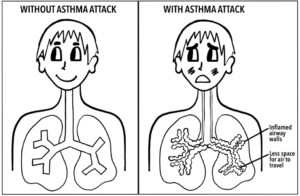
Asthma is a respiratory disease involving episodes of breathlessness and wheezing, often triggered by intense exercise, cold weather, breathing polluted air, or having a cough or cold.
These triggers stimulate the immune system of someone with Asthma to cause airway inflammation.
During airway inflammation, blood vessels in the airway walls get wider and allow water to escape from them. This makes the airway walls get big and puffy, so there’s not enough room for air to travel inside the airways.
Breathlessness and chest pain happens because it’s hard for asthmatics to force air through their narrow airways. Wheezing is heard when thin jets of air woosh through narrow airways at high speed.
Around 8 million people in UK have Asthma. There’s a large variation in Asthma severity, and a wide age range of Asthma patients. Luckily, treatments for Asthma are very effective if used properly.
How is asthma treated?
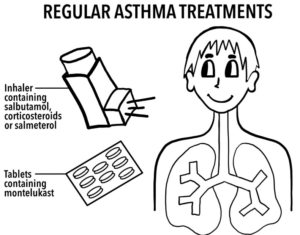
There are four main medications used to treat asthma. Three of them (called Salbutamol, Beclometasone and Salmeterol) are inhaled as a powders through a device called an inhaler. The other (called Montelukast) is a tablet taken daily.
- Salbutamol makes the airways get wider by increasing the action of adrenaline. Adrenaline creates a “fight or flight” response, which involves makes the airways wider to enable deeper breathing – which would be needed during fighting or running!
- Beclometasone is a type of Corticosteroid. Corticosteroids suppress the immune system to reduce inflammation.
- Salmeterol has the same action as salbutamol (increasing the effect of adrenaline), but works for a longer period of time than salbutamol.
- Montelukast decreases airway inflammation by blocking chemicals called leukotrienes which are made by the immune system to enable inflammation.
Patients with mild asthma might only need a Salbutamol inhaler, whereas those with severe asthma use all four medications.
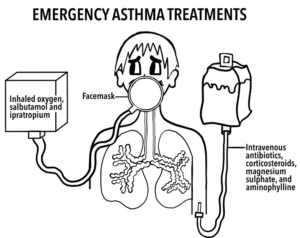
If asthmatics are rushed to hospital with an “asthma exacerbation” (feeling dangerously short of breath and unbearably wheezy for an unexpectedly long time), the treatments are slightly different.
- If the patient does not have enough oxygen in their blood, they are given a facemask through which they can inhale more oxygen.
- If the patient has a bacterial chest infection that caused the exacerbation, they are given antibiotics.
- It is important to quickly widen the patient’s airways using Salbutamol and Corticosteroids. If these don’t work, there’s three more medicines that might help – called Ipratropium, Magnesium Sulphate, and Aminophylline. They each employ slightly different mechanisms to decrease the harmful effects of airway inflammation.
That’s rather a lot of asthma medications for the doctor to remember! However, as an asthma patient, the most important thing to remember is to take the medications and carry an emergency inhaler to use if needed.



Visit
What's on
Learn and play
Youth Scheme
Quick links
Website by Hut Six Digital
