Why have we evolved to taste different flavours?
By Devan

Our sense of taste is one of our superpowers. It has allowed for the creation of magnificent food all across the world. However, our survival does not depend on delicious cakes and noodles (unfortunately!). So why have we really evolved this ability to taste, and why is it important?
Firstly, let’s define taste. It is one of our senses, allowing us to tell apart substances that enter our mouth. When food enters the mouth it lands on the tongue, where thousands of taste buds are found, each made up of millions of cells. There are different types of taste buds which detect different chemicals found in food. Different taste buds recognise the 5 different types of taste: salty, sour, sweet, bitter and umami (a savoury taste).
Each cell sends information about what flavour they have found through nerves to the brain. In the brain, these taste signals interact with lots of other systems. For example, the dopamine system which is involved in our feelings of reward after a good experience is often stimulated by certain tastes.
But why do we have these 5 different tastes? Why don’t we just taste ‘good’ and ‘bad’ things? It turns out each of these flavours has evolved from our ancient ancestors to help our bodies in unique ways. Salty food helps us take in the ‘electrolytes’ we need, meaning we get important minerals for cells like nerve and heart cells to function. Cells recognising sour taste evolved in order to detect spoiled or rotten food, helping our ancestors avoid food that might have gone off. Sweet tastes are associated with glucose, one of the most important molecules for making energy in the body. Bitter tastes were frequently found in poisonous things, again helping our ancestors avoid nasty food. Finally, umami taste is found in food like meat or mushrooms. This is thought to have evolved to encourage us to take in amino acids for the growth and repair of muscle.
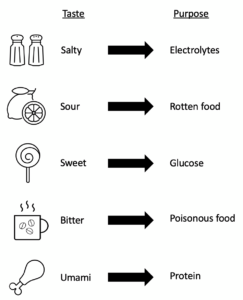
These tastes worked well for our ancestors trying to avoid poisonous fungi and rotten fruit as hunter-gatherers, and consume the necessary nutrients for a healthy body. However, nowadays we don’t have to worry about such things, but we can still detect these 5 flavours. This is because the ability to taste is embedded in our genes. Our relationship with flavours, and food, has become much more complex than our ancestors. Many people now enjoy the bitter taste of dark chocolate or enjoy the sourness of a grapefruit.
Not all animals have kept the ability to taste these flavours. For example, the family of cats including lions, tigers, as well as house cats, are mostly unable to taste sweetness. This is thought to be because they have been carnivores for their whole evolutionary history, preferring meat with that umami flavour. Without a purpose to taste sweet things, as they are able to get all their nutrients from a meat-based diet, the genes enabling the detection of sweet tastes were lost in cats.
While the reason we as humans still taste many things may be left over from our evolution, it enables so many fantastic experiences, from a luscious lasagna with loved ones to a calming coffee with cafe.



Visit
What's on
Learn and play
Youth Scheme
Quick links
Website by Hut Six Digital
