How does blood make clots?
By Anoushka
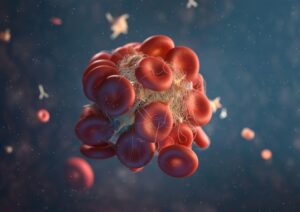
Blood clots are gunky lumps of solidified blood. Blood clots form when blood vessel walls get injured and where blood flow is turbulent (i.e. blood flows in many different directions, when it should just flow forwards). Once formed, blood clots exist for a while (from minutes to months) before the body destroys them. Blood clots are useful in preventing blood spilling out of damaged blood vessels. Blood clots are dangerous if they get big enough to obstruct blood flow through a blood vessel.
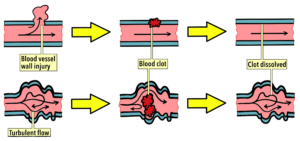
Blood clot formation
Blood clot formation involves the following components:
- Platelets: these are found in the bloodstream; they are made inside the bone marrow from fragments of cells called megakaryocytes.
- ‘Clumping chemicals’ which make platelets stick together: there’s quite a few of these, labelled in yellow in the diagram below.
- Thirteen clotting factors, named factors 1-13: they are all found in the bloodstream apart from factor 3, found in blood vessel walls.
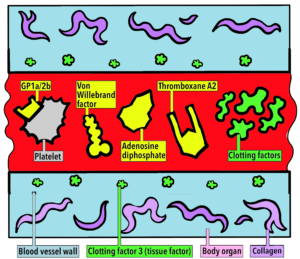
The following processes enable blood clot formation:
- Blood vessel wall damage means that collagen can react with platelets and clumping chemicals. This makes platelets clump together around the blood vessel injury.
- Blood vessel wall damage makes factor 3 (inside blood vessel wall cells) encounter other clotting factors (inside blood vessels), causing chemical reactions.
- Turbulent (i.e. higgeldy-piggeldy or multi-directional) blood flow encourages clotting factors to mix.
- Blood clots are mainly made from clotting factor 1, nicknamed ‘fibrin’. When fibrin reacts with the other clotting factors, it turns into a sticky spider’s web which surrounds and traps the clumps of sticky platelets.
Blood clot destruction
Blood clot destruction involves three mechanisms:
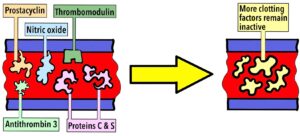
- Anticoagulation continuously hinders blood clot creation. Blood vessel walls release chemicals called Nitric Oxide and Prostaglandin which stop platelets from sticking together. Chemicals called protein C, protein S and antithrombin 3 and thrombomodulin prevent chemical reactions between clotting factors.
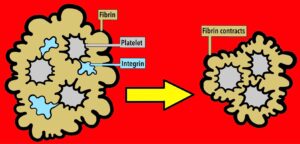
- Retraction makes blood clots shrink once they have formed. Platelets release a chemical called integrin α2βB3 which makes fibrin molecules contract.
- Fibrinolysis breaks blood clots back into clotting factors and platelets. Fibrinolysis happens because chemicals in the bloodstream called plasmin and tissue plasminogen activator cause
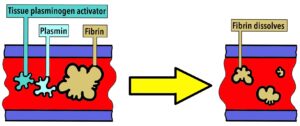
Conclusion
Achieving the right balance of clot formation and destruction is important to prevent dangerous bleeding and blood flow obstruction. I hope that you enjoyed reading about how blood makes clots!